
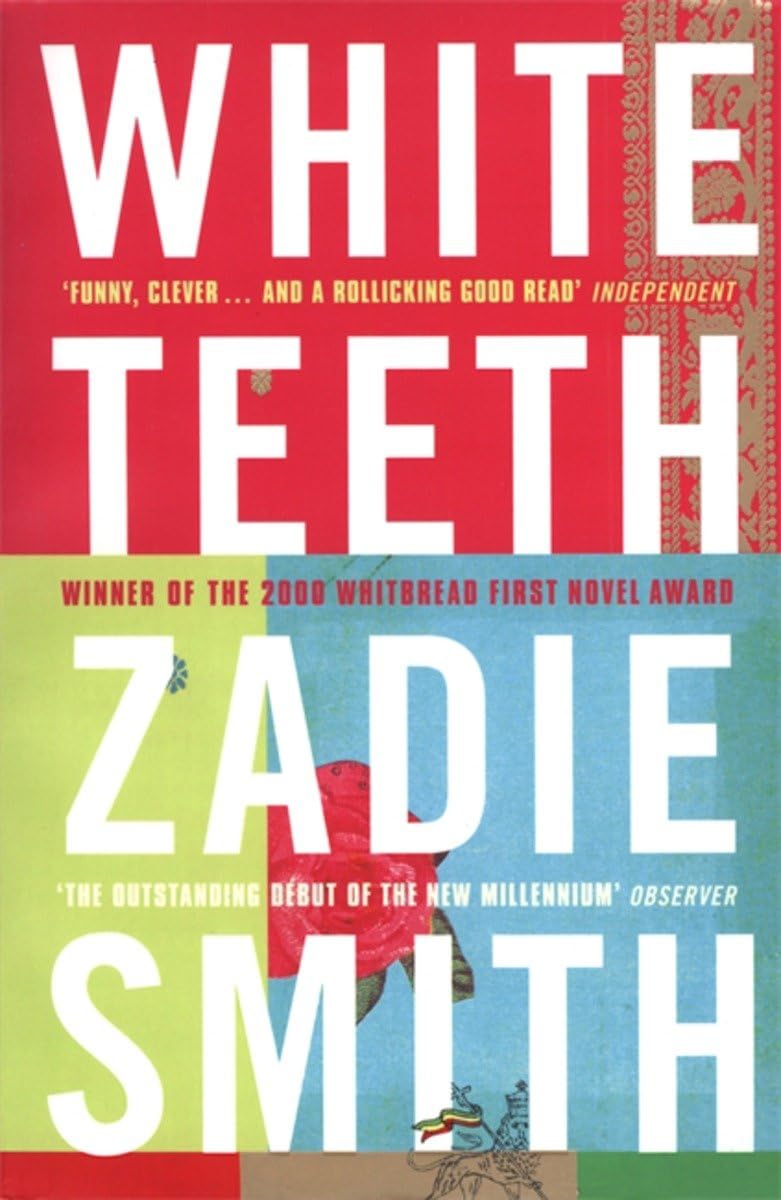
Review by Sayantani Biswas
Sayantani Biswas in this engaging review of White Teeth shows why Zadie Smith is such a great writer and how the book has helped her think about her own experience of navigating life in London. If you haven’t read White Teeth yet, this review tells you why you should put it on your summer reading list.
I’ve been meaning to talk about Zadie Smith’s “White Teeth” for a while. It’s one of those books that, once you finish, lingers in your mind you keep turning over, discovering new patterns each time. It’s not just a story; it’s a vibrant, multi-layered exploration of identity, ethnicity, history, and the messy, beautiful chaos of modern life. it’s a novel that feels simultaneously intimate and sprawling, and that’s what makes it so compelling.
So, where do we even start? with the tone. Smith’s voice—so cunning, so warm, so sharp—really draws you in right from the beginning. She’s got this way of blending humour with serious social commentary, making you chuckle and s making you think. And that’s quite a balancing act, right?
Let’s talk about characters, because, they’re the heart of the novel. You’ve got Archie Jones and Samad Iqbal—two men whose lives are intertwined through history, culture, and the peculiar twists of fate. Archie, the British everyman, grappling with aging, regret, and a kind of existential boredom; and Samad, the proud, sometimes stubborn Bengali man, trying to hold onto his cultural identity amidst a rapidly changing world. These two are like archetypes, but Smith gives them so much nuance that they feel real, flawed, and relatable.
What’s fascinating is how she weaves their stories into the broader narrative of their children—Clara, Irie, and others who embody the next generation’s struggles with ethnicity, belonging, and the search for identity. It’s almost as if Smith is suggesting that history and culture aren’t just inherited like family heirlooms but are constantly being reconstructed by each new generation. That’s a pretty profound idea, isn’t it? That our identities are fluid, shaped by both our roots and the way we choose to stand on them.
Smith’s exploration of race and ethnicity is incredible. She doesn’t reduce her characters to stereotypes. Instead, she delves into their internal conflicts, their contradictions, their moments of doubt and pride.. Smith treats her characters as complex beings—flawed, funny, vulnerable—
Another thing that struck me is how “White Teeth” is essentially a meditation on history—personal, familial, and collective. Smith is good at threading the past into the present. For example, the secret about Samad’s son, the different ways the characters relate to their histories—these aren’t just plot devices; they’re integral to understanding who these people are. It’s like she’s asking us to consider: how much of our identity is shaped by history, and how much can we rewrite it? That’s the kind of question that sticks with you long after you turn the last page.
Smith’s wit is razor-sharp. She’s hilarious in a dry, understated way, poking fun at British pretensions, cultural stereotypes, and even her own characters’ follies. In a way, her comedy acts as a kind of buffer—allowing us to confront serious themes without feeling overwhelmed.
Now, the writing itself—oh, the writing! Smith’s prose is so lively, so elegant, it is one of those rare talents where she manages to be incredibly smart without sounding pretentious. Her sentences dance—they’re rhythmic, playful, sometimes poetic. She’s got this gift for capturing the vernacular, the rhythms of speech, which makes the dialogue feel authentic. And that authenticity draws you into her world, makes you care about her characters.
“White Teeth” is a novel about how tradition and change collide, how faith and science sometimes seem at odds, and how, despite all that, we’re all trying to find some kind of meaning or connection. It’s very much a reflection of Britain in the late 20th and early 21st centuries, but really, it’s universal. The questions she raises about multiculturalism, integration, and the migrant experience are definitely global in scope.
You know what’s also interesting? The way she plays with fate and free will. Characters make choices, but they’re also shaped by their histories and circumstances. It’s like she’s suggesting that our lives are a tangled web of agency and inertia—an idea that’s both comforting and unsettling. Because it reminds us that while we have some control, we’re also subject to forces beyond our understanding.
Reading “White Teeth” while trying to survive as a newcomer in London feels less like analyzing literature and more like looking into a beautifully chaotic mirror. Zadie Smith completely nails that exact feeling of being overwhelmed by this city, where you’re constantly trying to figure out how your own history fits into London’s grand, messy mosaic. When you first arrive—whether you’re an international student landing with a mountain of luggage or a migrant trying to build a new life—you’re hit by the sheer, dizzying velocity of the place. The brochures and movies promise this glamorous, experience, but the reality on the ground is a lot more visceral. The financial culture shock alone is enough to give you whiplash. You watch your hard-earned savings convert into British pounds and instantly shrivel up, turning a simple trip to the supermarket or a casual pint into a high-stakes maths problem.
Then comes the rite of passage: navigating the nightmare of the London housing market, dealing with sketchy landlords, and trying to find a sense of “home” in a cramped, slightly damp room in Zone 4. Like Samad Iqbal, you quickly develop a hyper-awareness of your own foreignness. You learn to code-switch without thinking about it—tweaking your accent so the barista understands your order..But beyond the logistical hustle, it’s the emotional tug-of-war that really bridges the gap between your life and Smith’s pages. You might be sitting in a historic London library or working at a sleek office desk, completely surrounded by the architecture of the old British Empire, while simultaneously checking your phone to reply to a family WhatsApp group thousands of miles away. It’s that exact hybrid purgatory that Irie and Magid navigate. You’re physically walking through the gray, rainy streets of London, but your heart is still tethered to the warmth of home. There is this constant, quiet anxiety that the longer you stay here, the more your edges are being softened and blurred by British life, making you wonder how much of your original self you’re accidentally leaving behind on the Tube. Yet, just like the novel, the true beauty of the experience is wrapped up in the utter absurdity of it all. London can be brutal, but it is also incredibly alive. You find your true community not in neat, curated spaces, but in the shared survival tactics of other newcomers. You bond over visa stress, the ridiculous price of rent, and the collective trauma of navigating British bureaucracy. In the end, relating to White Teeth means realizing that life in London isn’t a cinematic fairytale. It’s a messy, expensive, beautiful negotiation of who you were, who you are, and who you are actively becoming on these streets.
So, wrapping this up——what do you think Smith is really saying about identity? Is she optimistic or cynical? Personally, I think she’s somewhere in between. She’s acknowledging the fragmentation and contradictions, but also in a way highlighting the resilience and humour that keep people going. It’s a celebration of human complexity,
In the end, “White Teeth” feels like a love letter to London, to multiculturalism, and to the imperfect, messy, beautiful human experience. It’s a novel that makes you think, makes you laugh, and maybe even makes you a little more empathetic. And isn’t that what great literature should do?