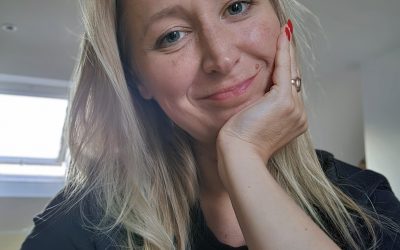
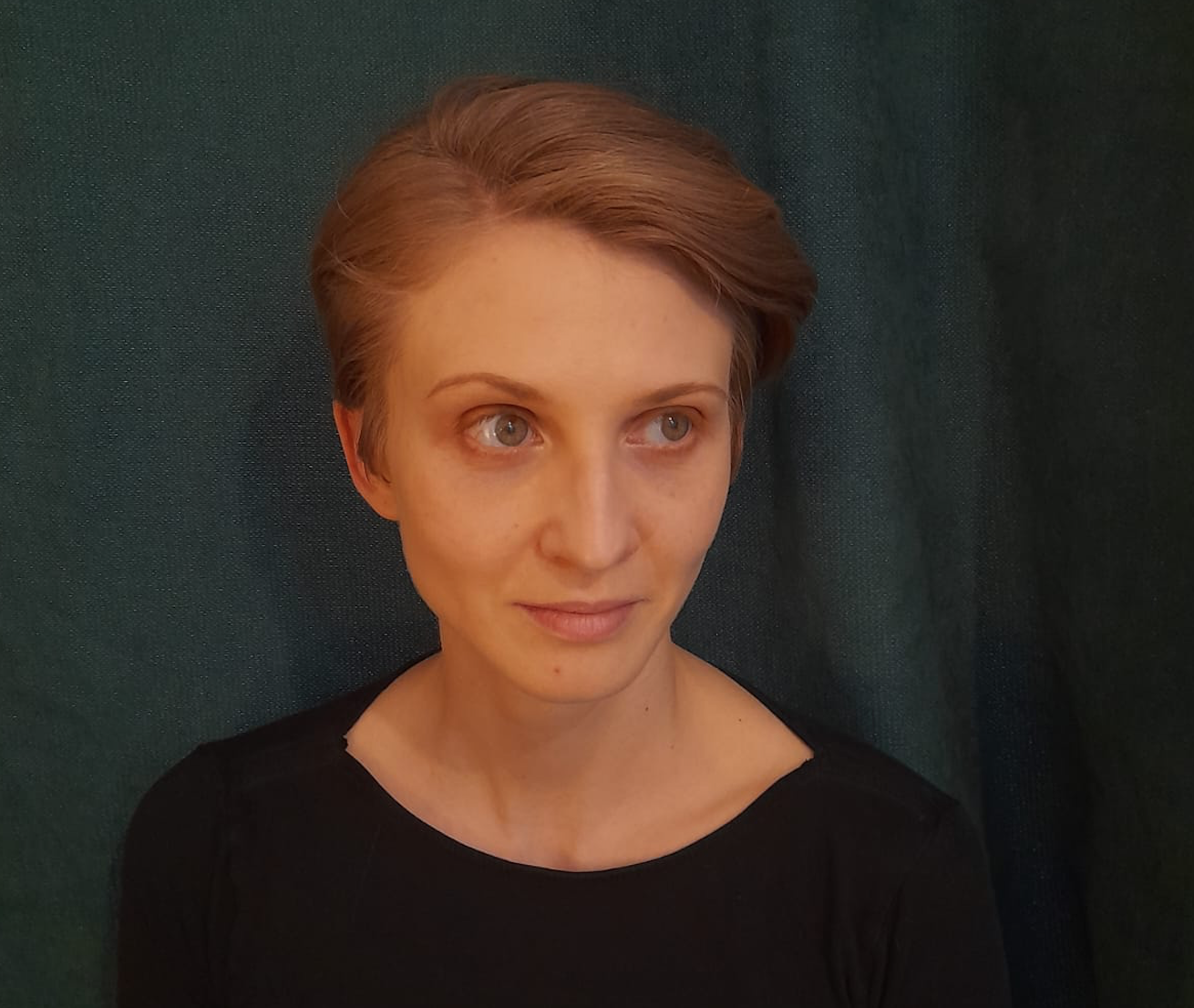
In this beautifully written essay, Maria-Irina Popescu describes their journey emigrating from Romania to the UK, reflects on the challenges of following your creativity and how to gain a community and your voice.
By: Maria-Irina Popescu
Growing up in post-Communist Romania, we had a pagan-Christian hybrid of traditions, some alive only in the countryside, others carried into cities like my own, Constanta, on the Black Sea. Some, I carried in my luggage when curiosity urged me to try my luck out West, in the UK. In December Saint Nicholas filled our boots with chocolates if we behaved or left a stick if we didn’t. On Christmas Eve we sang carols, opened presents beneath a tinsel-draped fir tree, and ate pork cooked in a hundred different ways.
The year turned with rituals of abundance and renewal: coins hidden in cheese pie on New Year’s Eve, the blessing of waters on Epiphany, red-and-white ribbons tied to our wrists to greet spring. On Easter Eve we stayed up until midnight to light candles said to carry holy fire from Jerusalem, then cracked dyed eggs and devoured lamb at lunch. In the countryside groups of calusari, men with bright ribbons streaming from their hats and bells tied to their ankles, danced to summon spring.These rituals taught me how community devises meaning and belonging. As I grew older, I carried that sense of shared rhythm with me, even before knowing I’d need it elsewhere.
Folklore and religion, however, never gave me space to be myself. My faith, if I had one, was in the imagination: not in what’s been, but in what could be. My favourite tradition was an intellectual rite: the annual Olympiad, a competition where pupils across the country tested their knowledge for the sake of certificates and bursaries, and most importantly, glory. I began observing at eleven. There were stages: school, local, regional, national for the over thirteens – and the international for the best. The school stage came in December, the national in April. Preparation began in summer.
At secondary school I was a straight-A pupil, good at everything. I entered maths, biology, French – and I never returned from regionals empty-handed. In Year 7, I qualified for the nationals in Romanian Language in Literature. Training stirred intellectual curiosity in my awkward, atheist, socially inept body. Something like vocation. It wasn’t new. At eight, writing ‘compositions’ in primary school, I told my mother I wanted to be a writer. I kept scribbling.
Now, studying for the Olympiads, it felt possible to make a career out of my passion for stories, where I glimpsed a home. had never been a child at home in the world. Quiet yet restless, lonely, sometimes bullied. Despite my family’s vigilance I craved attention. n literature I felt seen. I could be myself and make sense of reality.
My first national Olympiad was in Galati, a port on the Danube. We travelled by train, stayed in crowded dorms. I didn’t mind; it was freedom. I returned with a commendation and a kohl pencil bought with prize money. I was hooked. For the next six years I was a fixture of the national Olympiad, travelling across Romania: museums, monasteries, the ancient woods that inspired our poets. Established writers read to us, signed books, congratulated us.
I didn’t notice the austerity – the narrow desks, the single beds. All I saw was the romance of following your passion. At sixteen I won first prize with an essay comparing Romanian modernism to Proust and Gide. It felt like destiny: a future devoted to literature. And what a glorious future it seemed!
The international stage was less competition, more celebration: a festival of the Romanian-speaking diaspora. Presenting on my hometown’s multicultural past, I won best speaker and tossed my cards in the air as applause rose. The world felt vast, full of possibility.
University abroad came next. By eighteen I was tired of finding comfort only in books. I wanted a life I could fit in – authentic, unrestricted by patriarchy or tradition. Curiosity, that old spark, led me to the UK, taking advantage of the recently acquired freedom of movement. From the news I knew immigrants weren’t always welcome, but I was determined to carve out a space for myself. To prove my worth.
My English was fluent, yet I lived in quiet fear of mistakes – of a misused article, a flattened vowel, too ornate a sentence. I was afraid of betraying myself as an outsider. Fluency, I learnt, is not the same as belonging. Language can both open doors and remind you you’re still outside looking in. I worked tirelessly, tied worth to output. The 2010s worshipped productivity; I mistook it for meritocracy. I wrote the best essays, earned the best marks, read endlessly. I worked minimum-wage jobs, learnt humility. I met a white English boy, kind and curious, and hid my shame behind perfection. Friends came second. Vulnerability wasn’t an option.
In the next decade I earned a First Class degree, a Master’s with Distinction, a funded PhD – all in Literature. I worked to exhaustion. Denied myself the smallest pleasures. Swallowed homesickness until my throat hurt. I returned to Romania once a year, at most.
I learnt British customs and culture. The British humour was a natural fit, complementing my Eastern European dryness. I embraced my partner’s family traditions, kept my own quiet.
I stopped dreaming up stories. Inside, it went quiet. Numb.
But the vocation of creativity doesn’t vanish when ignored.
So I left academia’s cold comforts and began to write stories again, following curiosity where certainty had failed.
From the start I’ve written my fiction in English – the language that both sheltered and alienated me. Writing in Romanian still feels like a distant dream, a homeland I have not yet found my way back to. Paul Celan, Tristan Tzara, Eugene Ionesco wrote in other languages, and their voices reached the world. I hope mine does too. In English I built a new home of words, one that holds my two selves in uneasy peace.
At first, it was torturous, fraught with doubt. It reminded me of a myth: master mason Manole, whose monastery crumbled each night until he sacrificed his pregnant wife within its walls. Only then did his legacy endure. I didn’t know whether my sacrifice – a career, belonging – would mean anything. Yet I kept writing.
The English boy kept reading my drafts, always believing. My parents, uneasy about my chosen austerity, supported me anyway, although I was building a life so different from theirs.
It took years to stop proving and start feeling safe again.
Yet safety, belonging – it takes so little for their light to dim! Even after all these years, a simple question, often delivered with good intentions – where are you from? – is enough to make me question my place and all I’ve built here – although I’ve paid taxes, voted in local elections, published articles, mentored students as they took first steps into English degrees. I showed up for family and friends, made daily commitments to be the best I could be, and kept going in challenging times.
The tension inherent in my story of migration isn’t easy to reconcile. I was born in a country trying to find its way back to sovereignty and freedom. I came of age in another – set to rule an empire, but with no empire left to rule. Too young to understand this, when I emigrated, I packed my things but forgot myself: what I’ve achieved, what I was capable of. I hollowed myself out, let the hatred of anti-immigration discourse delivered for political gain contaminate me because I didn’t yet know how to love myself. I didn’t know how to hold my partner’s, family’s, friends’ love for me, not yet. I labelled myself a stranger then fought to remove that label.
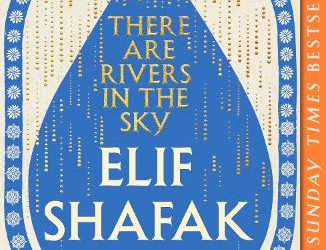
Writers’ homeland is storyland, said Elif Shafak. My storyland bridges two countries – one native, one adoptive – and stretches across continents. What’s been, what only exists in the imagination, what’s to come. Freedom, longing, justice, equity, beauty. Movement between the margins and the centre.
I learn to give back. At my writers’ club I comment on works-in-progress and support peers improve their craft. As my stories find their readers I understand that writing can be a bridge: between languages, traditions, the self I left and the self I became. And because I know that writing thrives through empathy and collective support, I co-founded a publishing project to nurture the multicultural local community. Pen Pals Tales helped nine writers, myself included, bypass gatekeepers and get their debut pieces out into the world.
My story of migration is a coming-of-age story. One about inner work rather than physical labour, with its own challenges. Because when an overachieving child grows up, it feels like a fall from heaven.
Working on myself and giving back, I gained a community that listens and a country that feels, however precariously, like home.
In today’s world, where everything and nothing is true, I know my voice to be real. It’s part of a wider chorus of nonconformists who keep this country’s – this planet’s – story growing.
So I stay curious, even when it’s hard.
Because curiosity is how love begins