
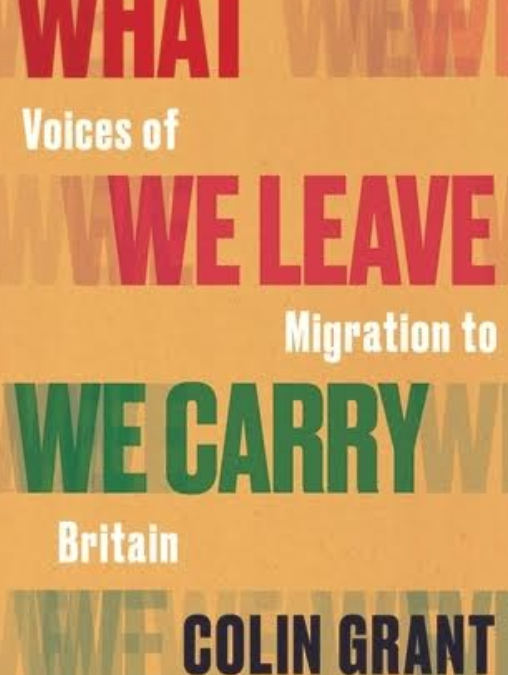
A review of What We Leave We Carry: Voices of Migration to Britain by Colin Grant
Review by: Sayantani Biswas
There is a particular kind of silence that follows you when you leave home. It sits beside you on the flight, appears in the quiet of an unfamiliar room, and sometimes returns in the middle of an ordinary day when a smell, a song or a familiar accent reminds you of everything you have left behind. Colin Grant’s What We Leave We Carry: Voices of Migration to Britain understands this feeling beautifully. It is a book about migration, certainly, but more than that, it is about people: their memories, their compromises, their hopes and their determination to make a life somewhere new.
Through a collection of personal stories and conversations, Grant introduces readers to people who have made Britain their home. Their backgrounds and circumstances differ, but each story adds another layer to the meaning of migration. We encounter, among others, a Czech-Roma lawyer, an Iranian taxi driver, a Sierra Leonean actor and a Romanian police officer. These are not simply examples of people who have moved from one country to another. They are individuals with complicated histories, professional ambitions, family ties and private emotions. By allowing them to speak in their own voices, the book moves beyond statistics and headlines and reminds us that behind every migration story is a human life that cannot be reduced to a label.
What I found especially affecting is the question at the heart of the title: what do we leave behind, and what do we carry with us? The obvious answers might be a house, a language, photographs or treasured belongings. But migration also involves carrying less visible things: the expectations of family, the memory of childhood, the habits of a culture, the ache of missing a loved one and the pressure to make the decision to leave worthwhile. Sometimes people leave because they want opportunity; sometimes because they need safety, work or a fresh beginning. Whatever the reason, arrival does not mean that the past disappears. It travels with us, quietly shaping the people we become.
Reading the book through the experience of studying in London gives this question an especially personal resonance. Coming to London as an international student can feel exciting and overwhelming at the same time. The city offers possibility at almost every turn: people speaking different languages on the Tube, food and traditions from across the world, and the sense that countless lives are unfolding side by side. Yet there are also small, less visible challenges. You learn to navigate a new academic system, understand unfamiliar social cues, manage expenses, find your community and build a routine without the everyday support of home. A video call with family may help, but it cannot quite replace being at the table with them. Even a successful day can end with a sudden longing for something ordinary and familiar.
For me, graduation brings its own complicated emotions. It is a moment of achievement, but also a reminder that the journey does not neatly end when the course does. The question changes from “Can I make a life here?” to “Where do I belong now, and what comes next?” For many international graduates, the future involves decisions about work, visas, distance from loved ones and whether to stay or move again. You may feel proud of how much you have adapted while still missing the person you were before you left. Grant’s collection makes room for precisely these contradictions. It suggests that belonging is not always a fixed destination; it can be something we negotiate, lose, rediscover and create over time.
The book also encourages us to look more carefully at the word “migrant”. In public conversation, it can become a distant category, often surrounded by suspicion or political argument. Grant’s approach challenges that distance. When we listen to individual voices, the word becomes less abstract. We begin to see workers, neighbours, artists, professionals, parents and friends. We see people contributing to the places where they settle, while maintaining connections to places they have left. Britain itself is shaped by these overlapping journeys. Its streets, workplaces, institutions, food, music and everyday conversations tell a much richer story than any narrow idea of national identity can contain.
One of the collection’s strengths is its range. No single account can stand for every migrant, and we see this in the book, Migration can be joyful and painful, chosen or forced, liberating and exhausting. Some people may feel at home quickly; others may spend years negotiating the distance between how they see themselves and how others see them. The different voices resist the temptation to offer one simple conclusion. They ask us instead to listen with patience and to accept that identity can hold more than one place, language or sense of belonging at once.
If I had one wish as a reader, it would be that more people who rarely encounter migrant stories beyond the news would pick up this book. It has the potential to make us pause before making assumptions about someone’s accent, name, passport or place of birth. It reminds us that the person serving us coffee, teaching a class, driving a taxi or working in an office may be carrying a whole world of memories and responsibilities that we know nothing about. A little curiosity and kindness can make a new place feel less unfamiliar.
Ultimately, What We Leave We Carry is wonderful because it understands that migration is not simply an act of crossing a border. It is an ongoing act of remembering, adapting and beginning again. We may leave behind a home, but we do not leave behind everything that made it home. We carry our people in our stories, our culture in our everyday gestures and our past in the choices we make. For anyone who has ever lived between places, or wondered what it means to belong, Grant’s book offers something valuable: not an easy answer, but the comfort of hearing other voices say, in their own ways, “I know what that feels like.”
Recent Comments